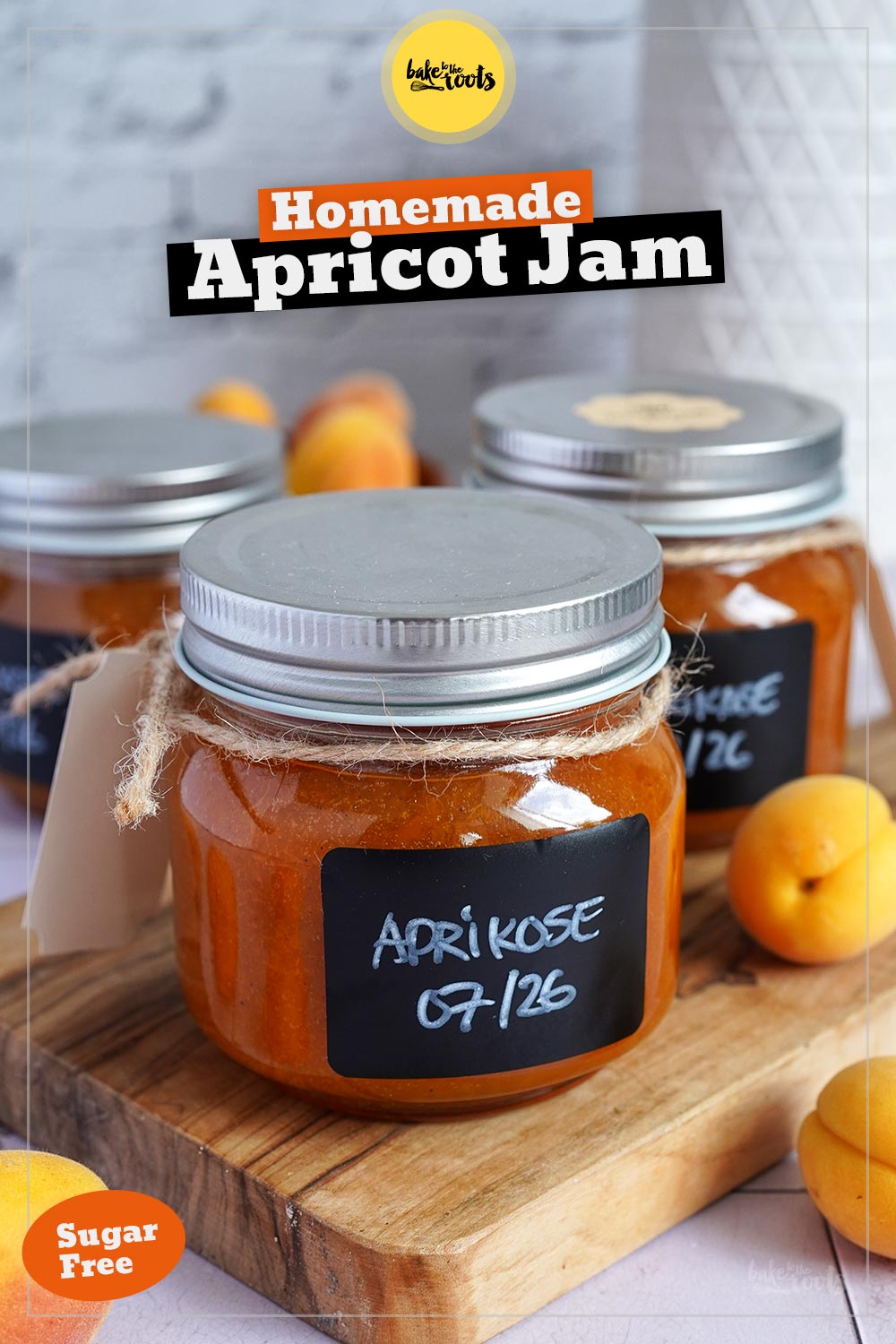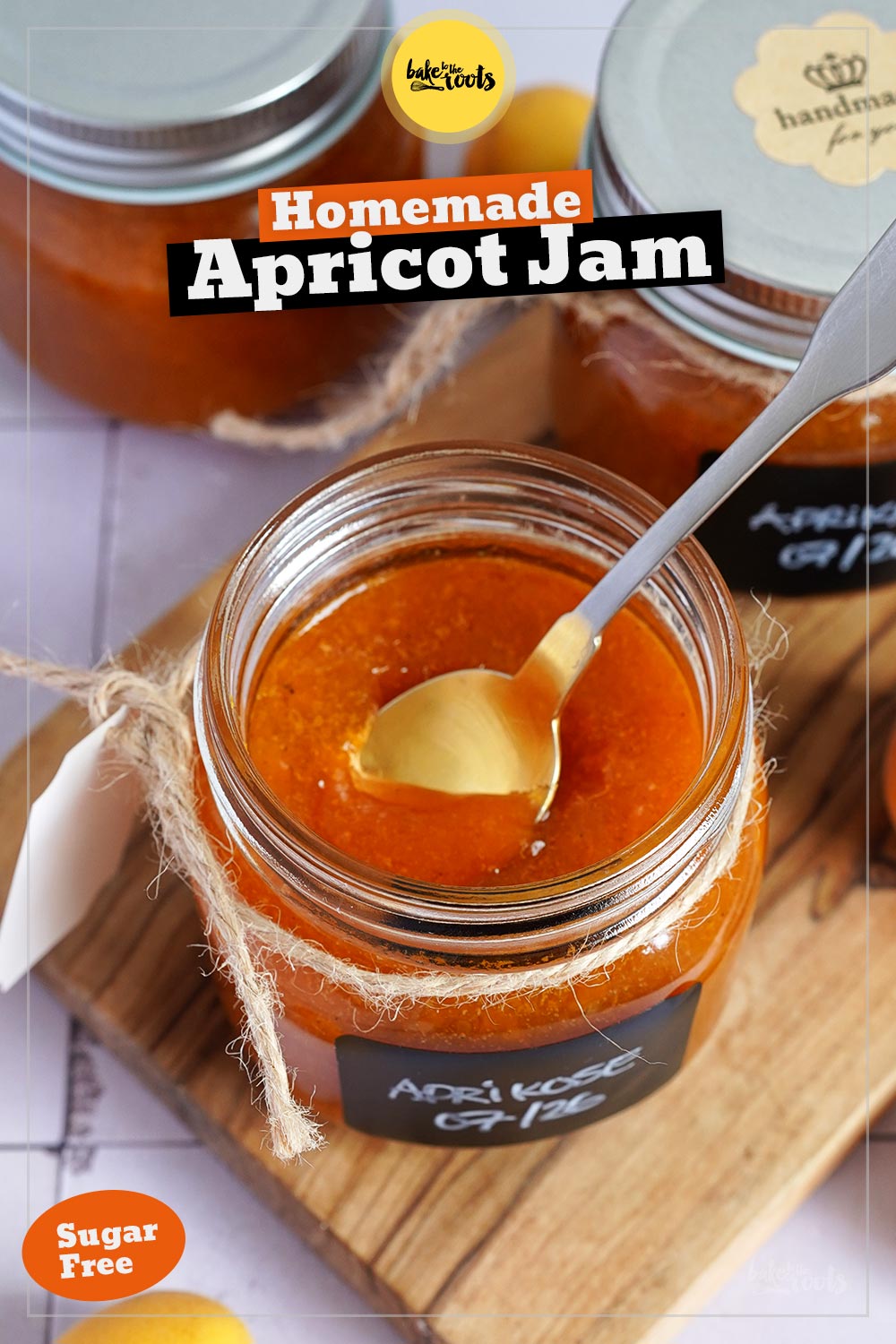


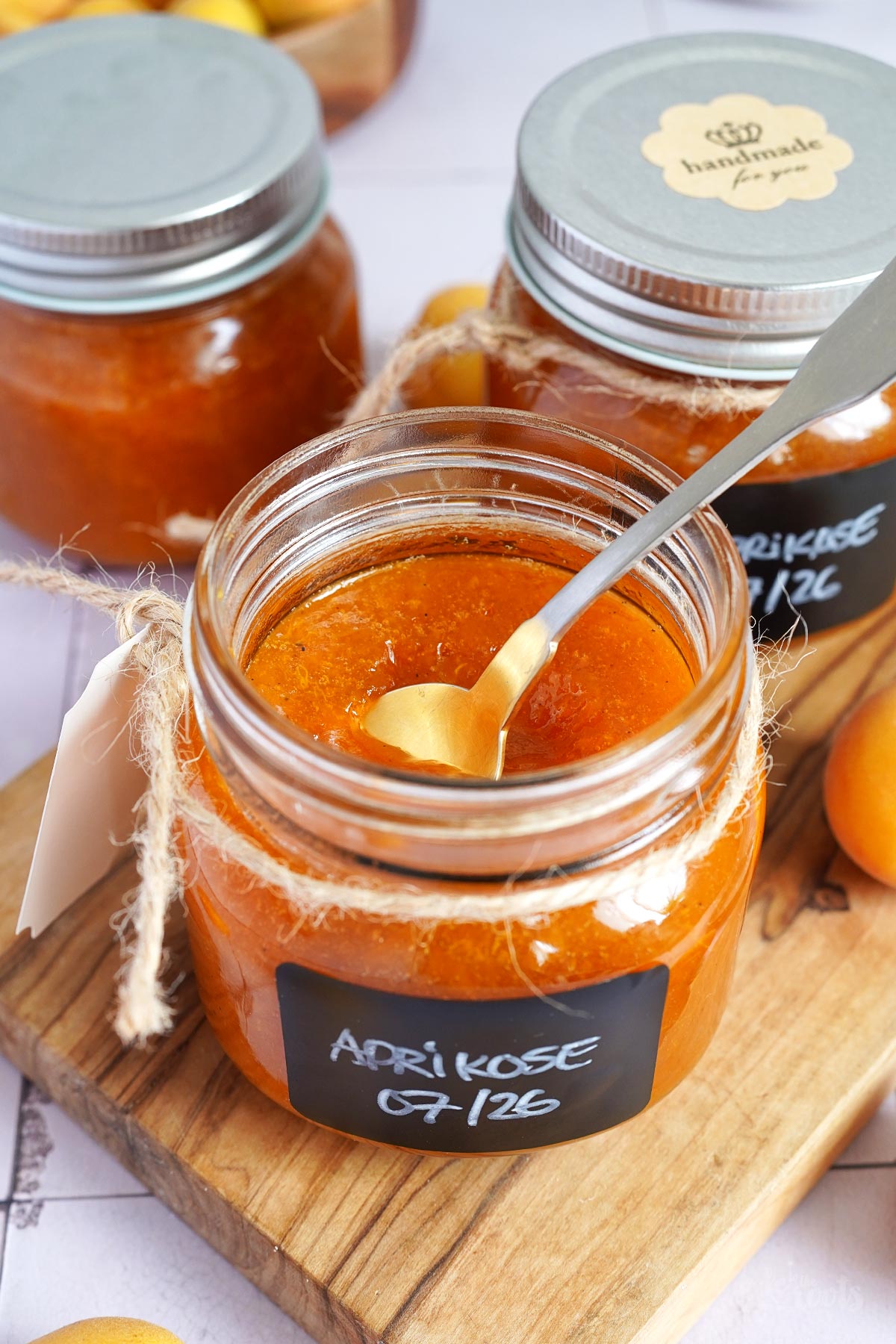
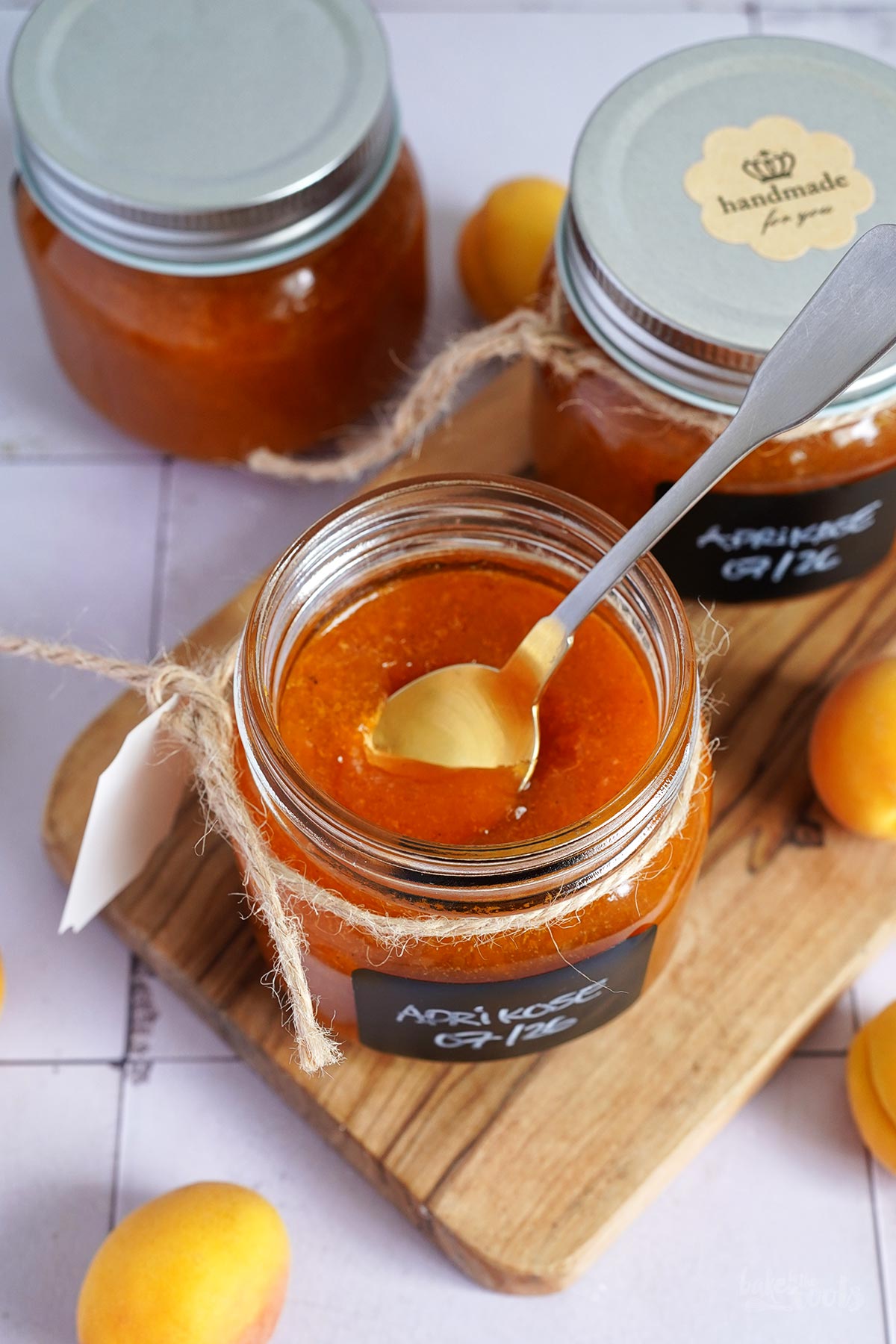
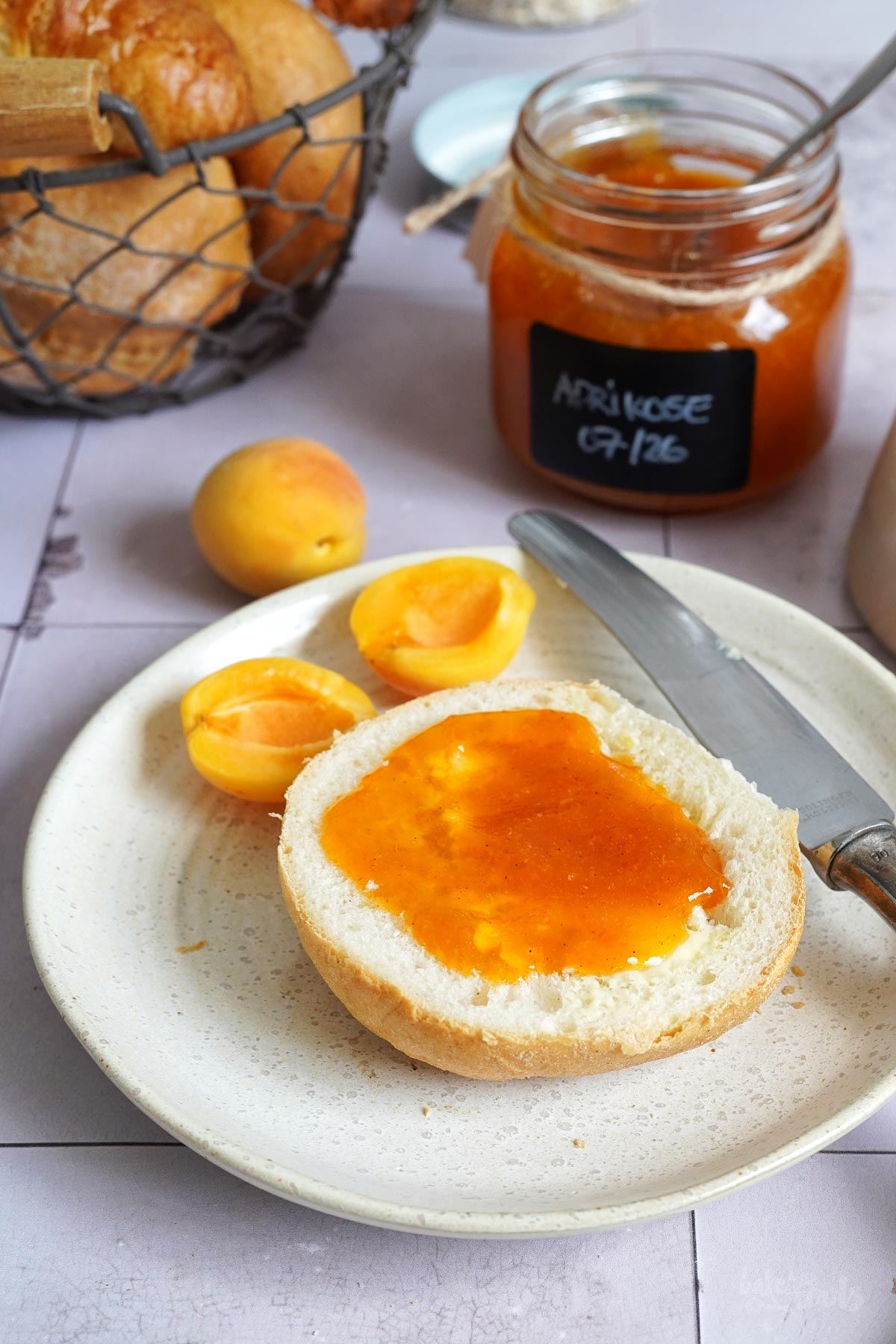
Over the past few years, we’ve made quite a bit of jam here at home – mainly because it’s still somewhat difficult to find jam without added sugar in supermarkets, and we simply prefer it over the sugary versions. A few of these jam recipes have already made it onto the blog, and this simple Homemade Apricot Jam is the latest addition to our collection of sugar-free jams. We greatly enjoy this delicious jam. It’s fantastic and also perfectly suitable for diabetics!
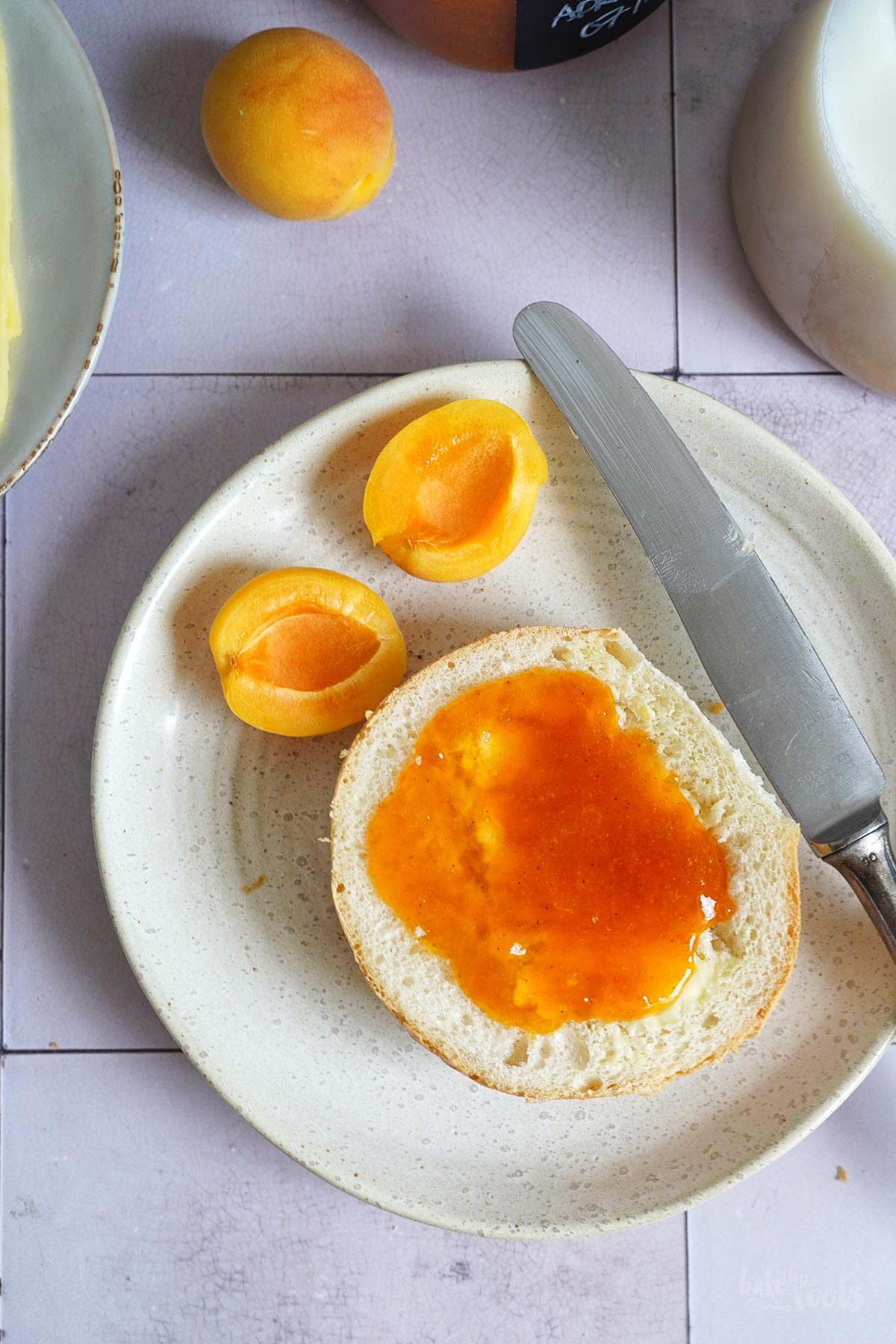
As some of you may know, I have been a diabetic myself for several years. To keep my medication intake to the absolute minimum necessary, I switched to a reduced-sugar diet a while back. Of course, not every diabetic needs to do this. Those who take insulin don’t necessarily have to worry as much about their sugar intake – they can simply adjust their insulin dosage based on the amount of sugar or carbs they consume.
Jam isn’t necessarily the kind of food where a »reduced-sugar« or »sugar-free« version is critical. Let’s be honest: most people don’t exactly eat the stuff by the bucket. If you don’t overdo it with regular jam – and perhaps opt for whole-grain bread instead of white bread at breakfast – you can certainly enjoy regular, sugary jam without any issues. BUT… as the old saying goes, »every little bit helps«. My grandmother always used to say, »save wherever you can«. She was talking about money, but the same principle applies just as well to sugar.
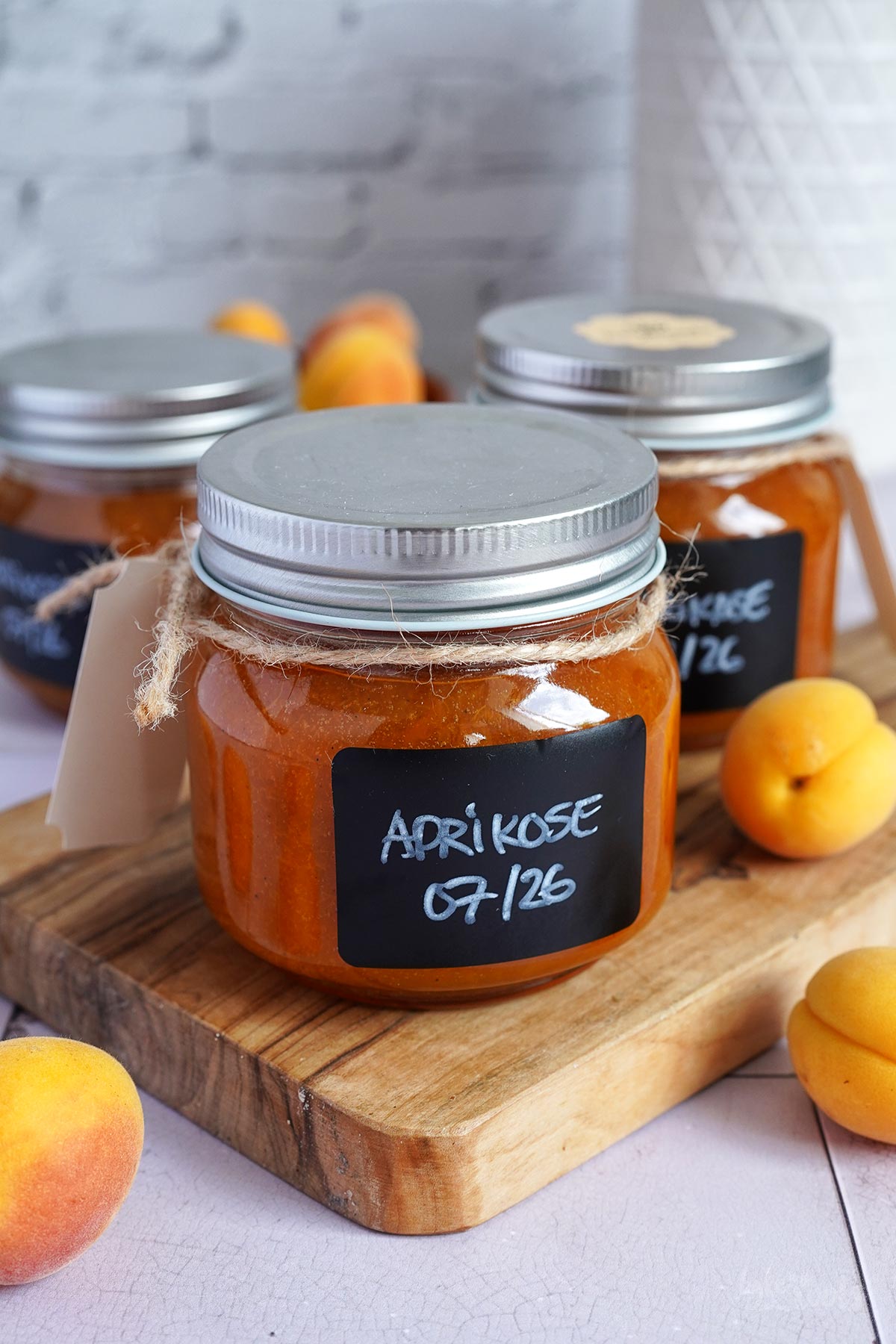
Sugar itself isn’t inherently evil. It’s the quantity that can cause problems for many people. In Germany, approximately 10.3% of the adult population has a medically diagnosed case of diabetes mellitus (as of 2024; source), amounting to roughly 11 million people. This group should, at the very least, be mindful of their dietary intake of sugar and carbohydrates. This jam is primarily intended for these 11 million individuals – as a potential alternative to conventional supermarket jams.
However, to avoid eventually joining this »chosen« group of diabetics, even those without diabetes should exercise a degree of moderation and occasionally be more sparing with their consumption of sugar. If you overtax the organs that help processing sugar, it could essentially happen to anyone to be »selected« by the disease – which is precisely how I ended up with diabetes in the prime of my life. Well…
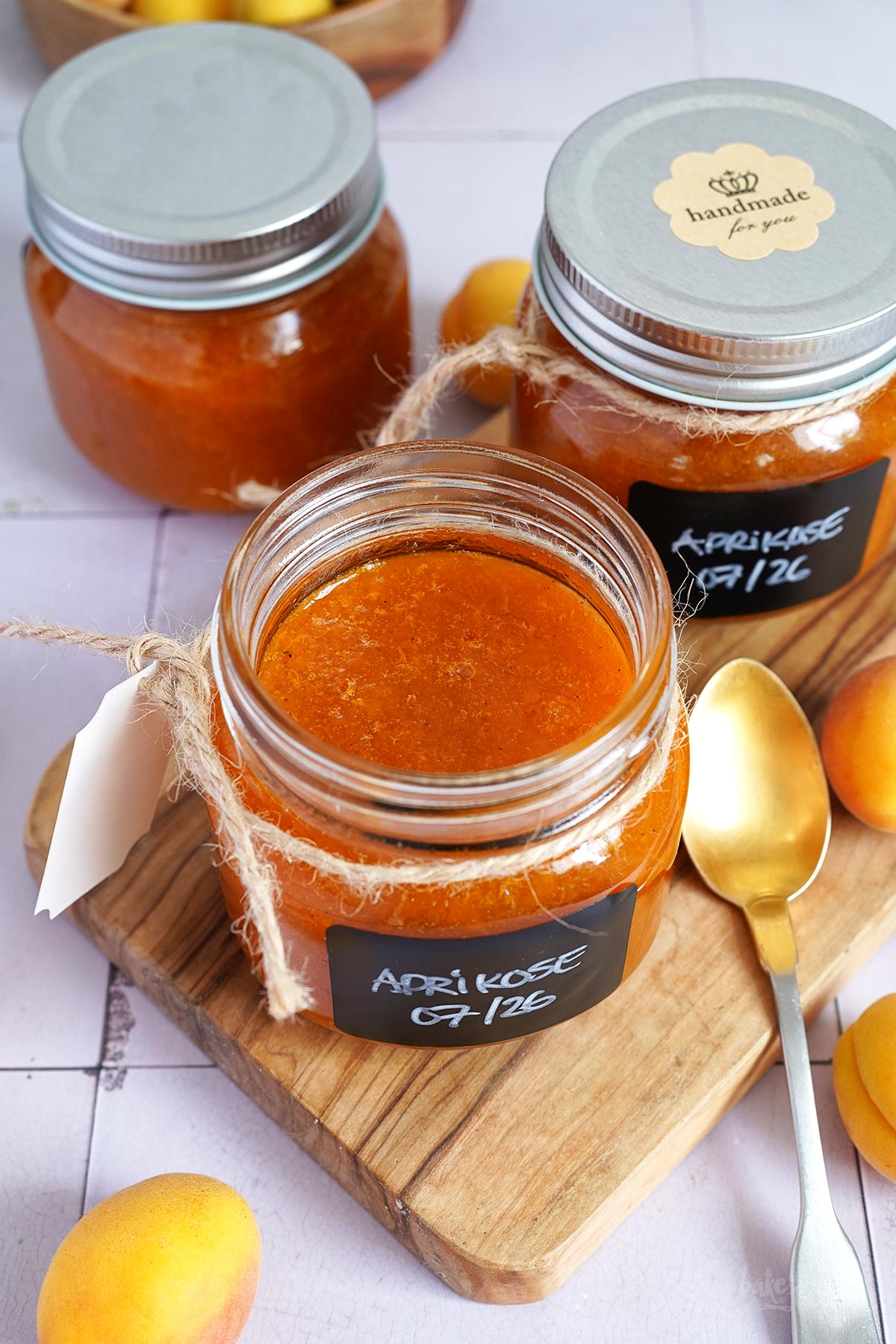
Conventional jam contains a relatively high amount of sugar – typically in a 1:1 or 2:1 ratio of fruit to sugar. In this context, sugar provides not only sweetness but also contributes to the product’s texture and long shelf life. If you leave it out, you need a substitute that functions effectively during the preserving process. Xylitol aka. birch sugar serves as a (let’s say) suitable alternative.
It can be measured just like regular table sugar, dissolves easily when cooking a jam, and contains about 40% fewer calories. Furthermore, it has a very low glycemic index of around 7 (sugar has a GI of around 60-70 in comparison), meaning it causes almost no spike in blood sugar levels. One drawback of xylitol is that it can have a laxative effect if consumed in large quantities. However, this is not an issue when spreading a small amount of jam on a bread roll. A crucial note for dog owners: xylitol is toxic to dogs, so please ensure this jam is stored out of their reach and never fed to them.

For this jam, fully ripe, aromatic apricots work best. They are naturally sweet while also containing enough fruit acid – an essential component for the jam to set. If the fruit is still a bit firm, that’s not a problem, just avoid using fruit that is very hard or unripe.
The gelling agent I used (Gelierfix 2:1) is designed for recipes with a lower sugar content. As the name suggests, it uses a ratio of two parts fruit to one part sugar (or sugar substitute). The lemon juice in the recipe helps the jam set and also helps preserve its color. Homemade jams, in particular, tend to lose their vibrant colors over time when stored.
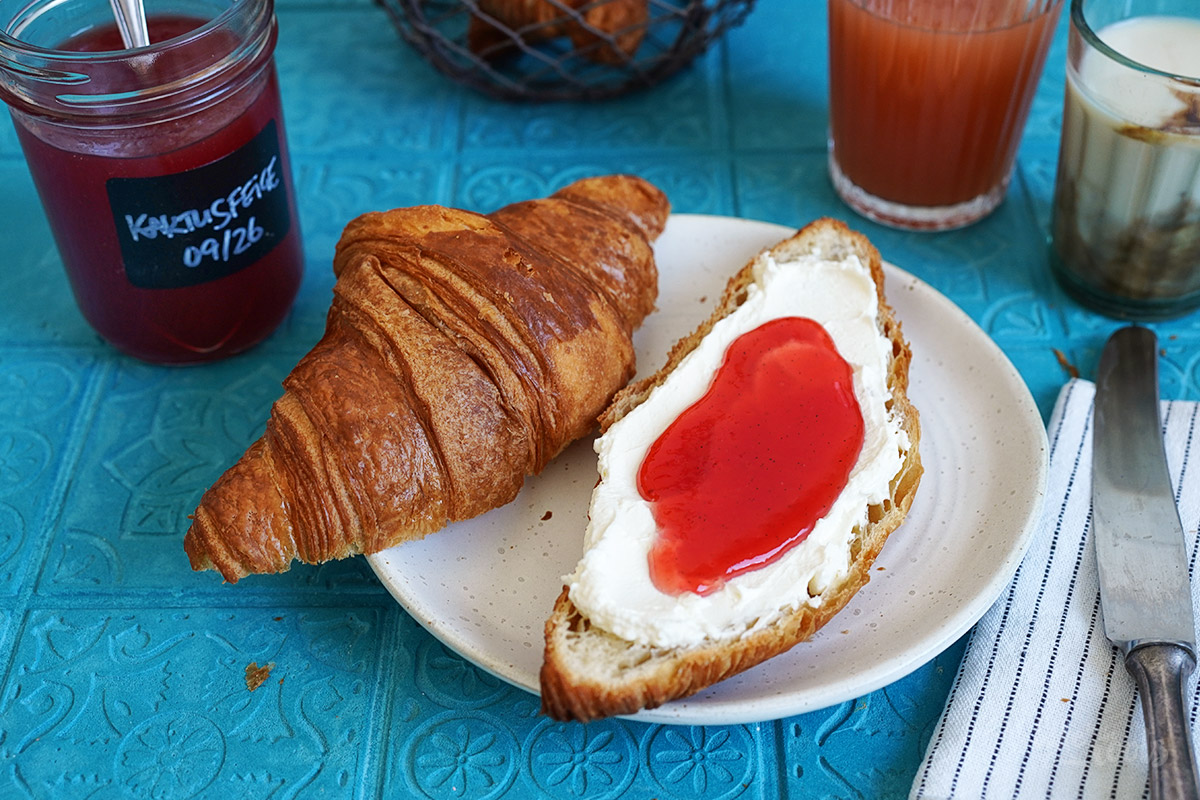
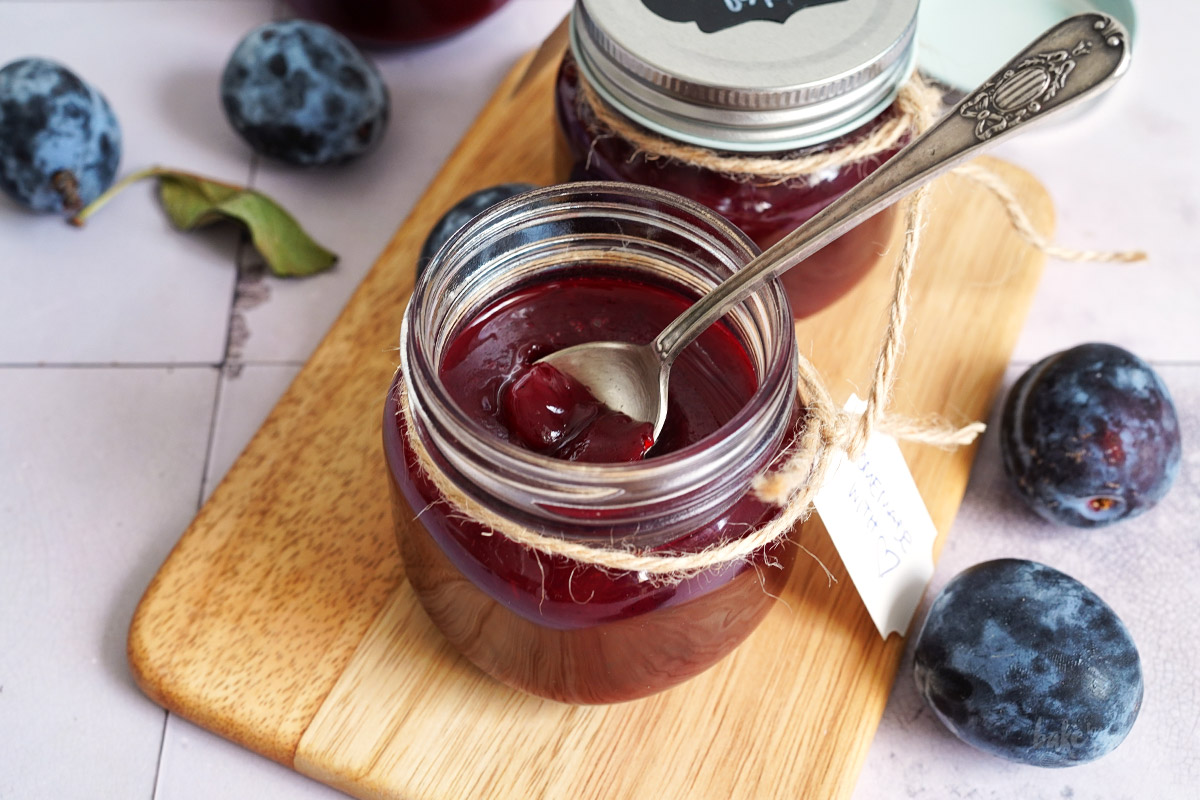
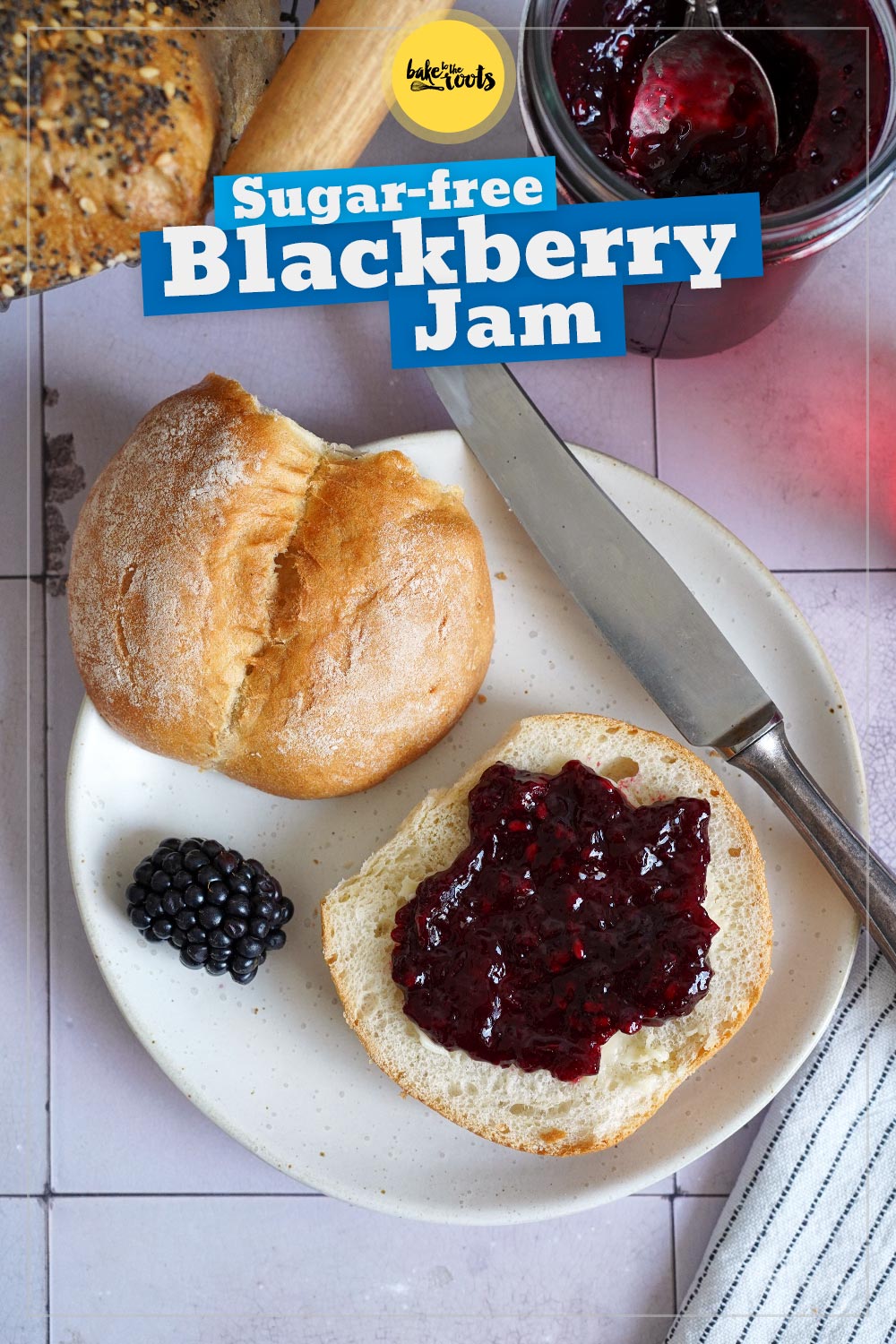
If you’d like to try more sugar-free fruit jams/spreads, take a look at these two recipes: our delicious Damson Plum Jam and our Sugar-Free Blackberry Jam – both are highly recommended if you love a sweet start to your day…
INGREDIENTS / ZUTATEN
(6 glass jars, 250ml each)
35 oz. (1 kg) fresh apricots, pitted
17.6 oz. (500g) xylitol*
1 sachet (25g) gelling powder (Gelierfix 2:1)*
1 tsp. vanilla powder*
2 tbsp. lemon juice
(6 Gläser à 250ml)
1 kg Aprikosen, entsteint
500g Xylit*
1 Beutel (25g) Gelierfix (2:1)*
1 TL Vanillepulver*
2 EL Zitronensaft
DIRECTIONS / ZUBEREITUNG
1. First sterilize the glass jars* and lids – either by boiling them in plenty of water or heating them in the oven. Be careful with the lids, they might not withstand the same heat as the glass jars. Set aside and let dry.
2. Wash the apricots, dry them, and pit them. Cut the apricots into smaller pieces.
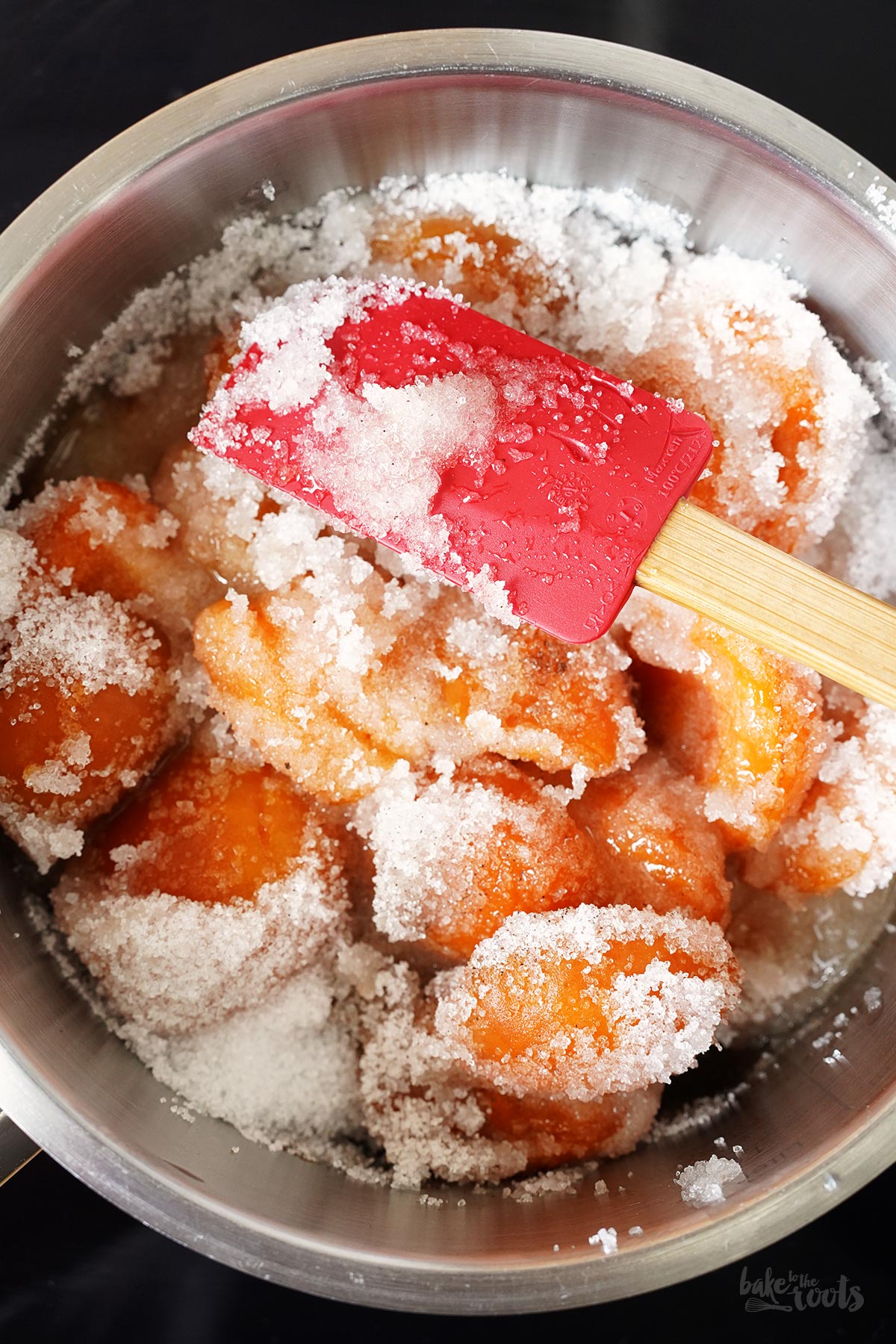
3. Combine xylitol, gelling powder (Gelierfix) and vanilla powder and add this together with the apricots and lemon juice to a (taller) saucepan. Mix to combine then purée everything using an immersion blender*.
4. Bring the mixture to a boil, then let it boil vigorously for about 4 minutes while stirring constantly. Do a gelling test (using a small plate) – if the jam sets quickly, it is ready to be canned. If not, simply cook it a tiny bit longer.
5. Transfer the jam to the prepared glass jars and seal them tightly immediately. There is no need to turn the jars upside down. Let them cool completely. Store the jars in a cool, dark place (e.g. basement). If you worked with clean equipment, the unopened jam should keep for at least 1 year. Once opened, store in the fridge and consume within 2–6 weeks.
Note: We don’t mind the apricot skins in the finished jam. If you don’t like that, you can pass the jam through a fine mesh metal sieve straight after boiling it down and then bottle it – that should remove the skins.
1. Die Einmachgläser* und Deckel sterilisieren – entweder in genügend Wasser auskochen oder im Backofen erhitzen. Vorsicht bei den Deckeln – die halten nicht automatisch so viel Hitze aus, wie die Gläser. Zur Seite stellen und trocknen lassen.
2. Die Aprikosen waschen, abtrocknen, entsteinen und in kleine Stücke schneiden.
3. Xylit, mit Gelierfix und Vanillepulver vermischen und zusammen mit den Aprikosen und dem Zitronensaft in einen (möglichst) höheren Topf geben. Alles gut vermengen und dann kurz mit einem Pürierstab* pürieren.
4. Die Mischung aufkochen lassen, dann unter ständigem Rühren etwa 4 Minuten sprudelnd kochen lassen. Den Geliertest machen (mit einem kleinen Teller) – wird die Marmelade zügig fest, kann abgefüllt werden. Wenn nicht, einfach noch ein klein wenig länger kochen lassen.
5. Die Marmelade in die vorbereiteten Gläser füllen und sofort gut verschließen. Auf den Kopf stellen ist nicht notwendig. Alles komplett abkühlen lassen. Die Marmeladengläser an einem dunklen, kühlen Ort (z.B. Keller) lagern. Wenn sauber gearbeitet wurde, sollte die Marmelade ungeöffnet mindestens 1 Jahr durchhalten. Nach dem Öffnen im Kühlschrank lagern und innerhalb von 2-6 Wochen aufbrauchen.
Hinweis: Wir haben kein Problem mit der Schale der Aprikosen in der fertigen Marmelade. Wer das nicht so gerne mag, kann die Marmelade direkt nach dem Einkochen noch durch ein feines Metallsieb streichen und dann erst abfüllen – so sollte man die Schale loswerden.
Craving more? Keep in touch on Facebook, Instagram and Pinterest for new post updates and more. You can also contact me with any questions or inquiries!
Here is a version of the recipe you can print easily.
Print
Homemade Apricot Jam (no sugar added)
- Prep Time: 00:20
- Cook Time: 00:05
- Total Time: 04:00
- Yield: 6 1x
- Category: Homemade Stuff
- Method: -
- Cuisine: Germany
- Diet: Diabetic
Description
Homemade jam is the best! This simple and easy homemade apricot jam is made without added sugar – this means it is perfect for diabetics and everyone who wants to cut back on sugar.
Ingredients
35 oz. (1 kg) fresh apricots, pitted
17.6 oz. (500g) xylitol*
1 sachet (25g) gelling powder (Gelierfix 2:1)*
1 tsp. vanilla powder*
2 tbsp. lemon juice
Instructions
1. First sterilize the glass jars* and lids – either by boiling them in plenty of water or heating them in the oven. Be careful with the lids, they might not withstand the same heat as the glass jars. Set aside and let dry.
2. Wash the apricots, dry them, and pit them. Cut the apricots into smaller pieces.
3. Combine xylitol, gelling powder (Gelierfix) and vanilla powder and add this together with the apricots and lemon juice to a (taller) saucepan. Mix to combine then purée everything using an immersion blender*.
4. Bring the mixture to a boil, then let it boil vigorously for about 4 minutes while stirring constantly. Do a gelling test (using a small plate) – if the jam sets quickly, it is ready to be canned. If not, simply cook it a tiny bit longer.
5. Transfer the jam to the prepared glass jars and seal them tightly immediately. There is no need to turn the jars upside down. Let them cool completely. Store the jars in a cool, dark place (e.g. basement). If you worked with clean equipment, the unopened jam should keep for at least 1 year. Once opened, store in the fridge and consume within 2–6 weeks.
Notes
We don’t mind the apricot skins in the finished jam. If you don’t like that, you can pass the jam through a fine mesh metal sieve straight after boiling it down and then bottle it – that should remove the skins.
Links marked with an asterisk (*) are affiliate links (advertising/Werbung) to Amazon Germany. If you click on one of those links and buy something via this link, I will get a commission for that sale. The price of whatever you buy is not affected in any way by this.